Before you see the table, you smell it: charcoal, fat, and a little caramel drifting down the lane just before noon. Bún chả, grilled pork and rice noodles with a warm dipping sauce, is the Hanoi lunch that sets the rhythm of the day. Here is how this classic comes together, one piece at a time.
Table of Contents
What is bún chả in Hanoi?
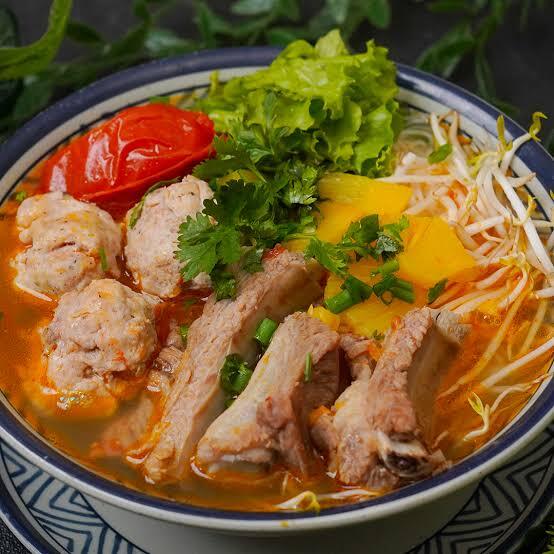
Bún chả is a dish of grilled pork and rice noodles, eaten with fresh herbs and a bowl of warm dipping sauce. It is thought to have originated in Hanoi, and it remains one of the city’s most beloved lunches. The name is simple and exact: bún is the rice vermicelli, chả is the grilled pork. Everything else on the table is there to serve those two.
Bún chả Hanoi and its place in the capital’s lunch hour
In Hanoi, bún chả is almost always eaten at lunch, and the city has kept to that habit. The grills tend to be lit in the late morning, and by the middle of the afternoon the lanes have gone quiet again. Lunch here has its own pace: quick, but never rushed. People leave the desk, find a low stool, eat, talk a little, and go back to work. Bún chả keeps the rhythm of the day in the way that seasonal cooking keeps the rhythm of the year.
How bún chả differs from bún thịt nướng
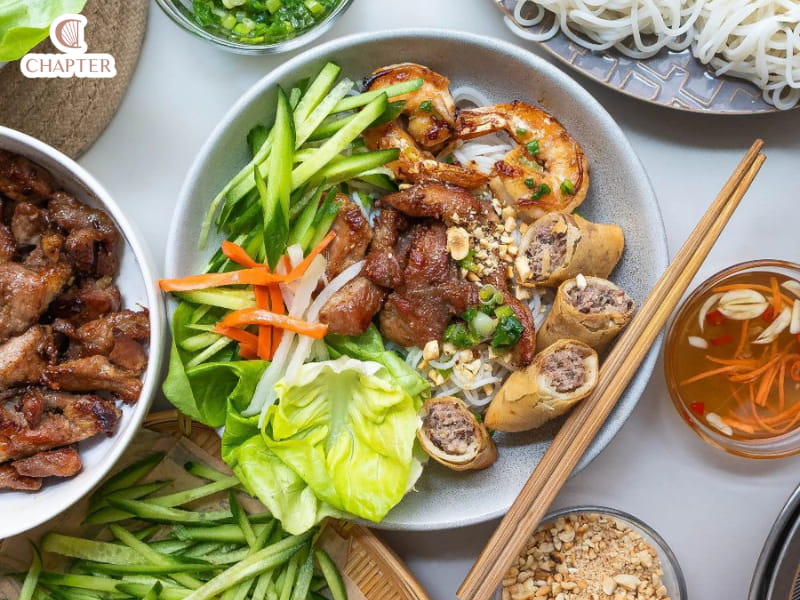
Travellers often assume bún chả is the same dish as bún thịt nướng, the grilled pork and noodle dish of the south. They are separate dishes with separate histories. Bún thịt nướng is served in a single bowl and tends to be sweeter, while bún chả arrives in parts and belongs to Hanoi. Keeping them apart is a small way to respect both.
What goes into a bún chả Hanoi set?
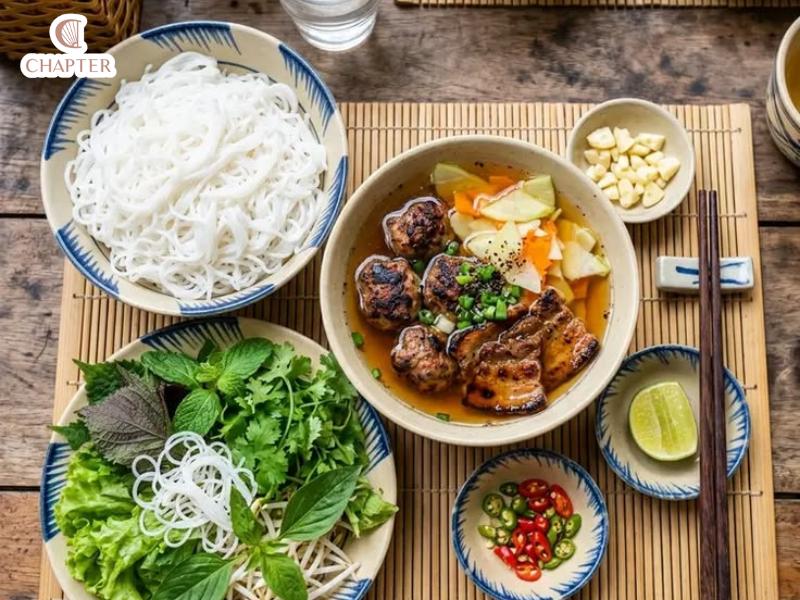
A proper bún chả Hanoi set has three parts that cannot be left out: rice vermicelli, two kinds of charcoal-grilled pork, and a warm dipping sauce. It never comes in a single bowl. The pork rests in the sauce, the noodles arrive on a plate of their own, and a basket of fresh herbs waits at the side, each part kept apart until you bring them together. We think about the plate in much the same way at Chapter, where our autumn menu names most dishes by their three ingredients and lets each one speak for itself.
Chả, the charcoal-grilled pork
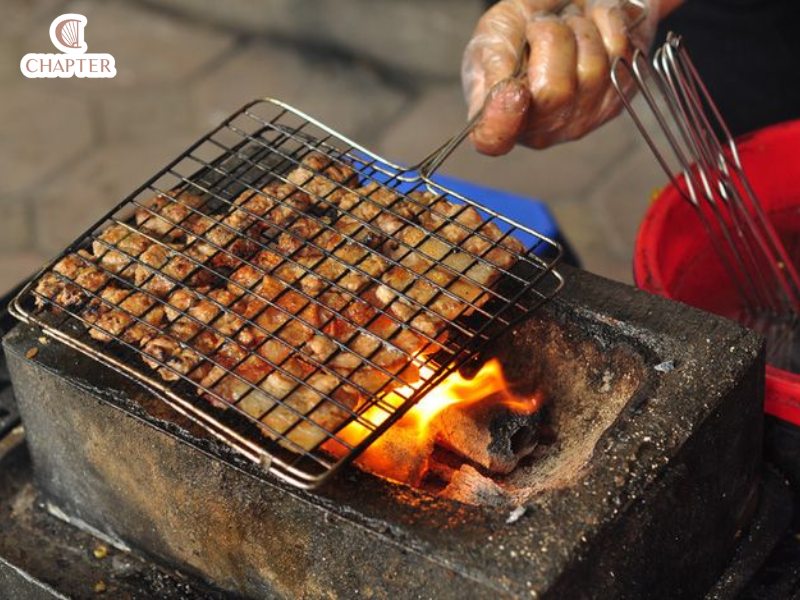
The heart of the dish is pork cooked over charcoal, in two forms: small patties and slices of pork belly. The patties are soft and savoury. The belly takes on a dark, caramelised crust at the edges while the fat underneath melts. Close your eyes and the whole plate is in the smell: smoke first, then sweetness, then the faint bitterness of the char.
Nước chấm, the warm dipping sauce
The pork sits in a bowl of warm sauce that balances sweet, sour, salty, and a little heat. It is usually built on fish sauce, sugar, lime or vinegar, garlic and chilli, and slices of pickled green papaya or kohlrabi often float in it. It softens the char, wakes the noodles and ties the herbs to the pork. Small dishes of crushed garlic and chilli, vinegar and sliced lime stand nearby, so each diner can tune the sauce to their own taste.
Bún and fresh herbs
Cool white rice vermicelli answers the heat of the grill, and a basket of herbs cuts through the richness of the pork: lettuce, Láng basil, rice paddy herb, bean sprouts and Vietnamese balm are typical. Their freshness is not decoration. Each leaf gives the mouth a place to rest between bites.
Nem cua bể on the side
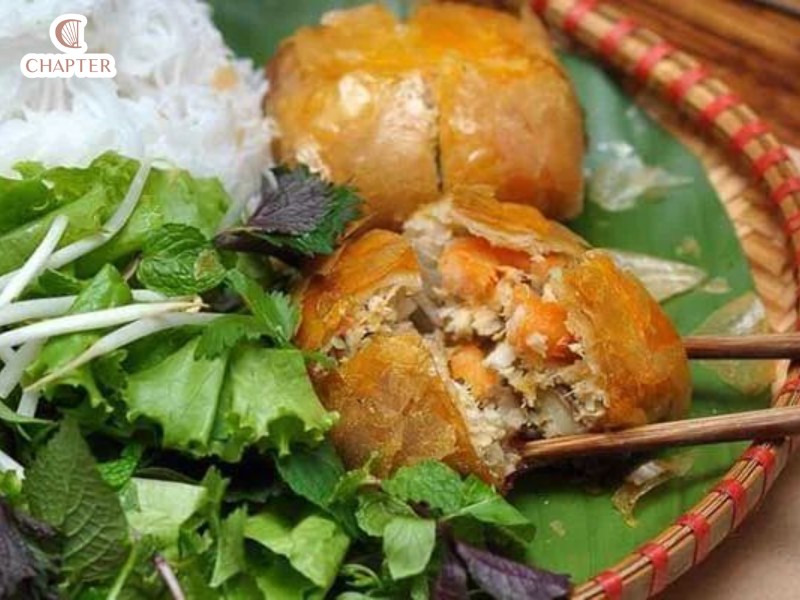
Fried crab spring rolls, nem cua bể, often arrive alongside the set. They are a separate dish, but in Hanoi the two travel together, a companion to the pork and not its heart.
How to eat bún chả the Hanoi way
Then the work begins, and it belongs to you. Lift a small bundle of noodles with your chopsticks and lower it into the sauce. Add a leaf or two of herbs, a piece of pork, perhaps a few drops of lime. Bring it all to your mouth while the sauce is still warm.
There is no strict order, but there is a habit most people follow: build slowly, in small turns. A few noodles, a few leaves, a piece of pork, then back to the sauce. Tipping everything in at once would drown the noodles, wilt the herbs, and cool the sauce too quickly.
What stays with you is rarely the flavour alone. It is the steam rising from the bowl, the click of chopsticks, the squeak of a plastic stool, the person beside you doing the same thing. Halfway through, you stop thinking about how to eat it, and your hands simply know. Bún chả is a meal made of many small movements, and that is why it feels so personal.
A short history of bún chả in Hanoi
No one knows for certain who first made bún chả, or when. Its beginnings seem to have been lost to history, which only adds to its pull.
Bún chả in Hanoi’s Old Quarter
The first bún chả restaurant in the city is said to have been on Gia Ngư street, in the Old Quarter, and Hanoians are believed to have eaten the dish as a street lunch there since the early twentieth century. Details differ from one account to another, so it is best to treat the story as a tradition rather than a record.
Bún chả in Hanoi’s food writing
In 1959, the writer Vũ Bằng described the city as spellbound by bún chả. By then the dish was clearly no newcomer, and it has stayed part of Hanoi’s written memory ever since.
Bún chả and the street dishes at Chapter Hanoi
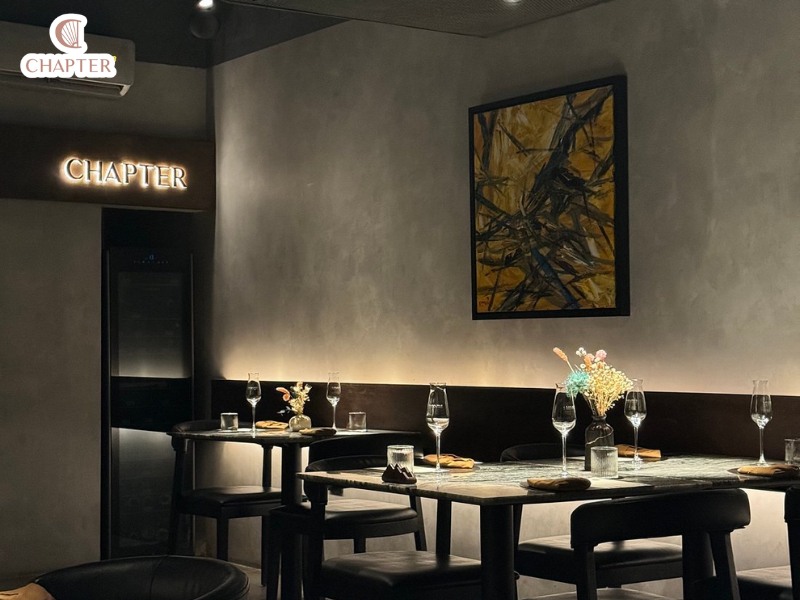
A kitchen can learn a lot from a street table. Bún chả puts each element on its own, then trusts the person eating to bring them together: smoke, sweetness, acid, freshness, cool noodles. Nothing is hidden, and nothing is there for show.
That is close to the idea at the centre of our menu, where each ingredient is allowed to speak for itself, and a dish is often named by three of them. The same attention runs through the street classics we cook at Chapter Hanoi, from the bánh mì to the phở gà.
If you find yourself in Hanoi this autumn, we would be glad to welcome you to our table.
________
Chapter Dining
12C Chan Cam, Hoan Kiem, Hanoi
Mon – Sat from 18:00 – 23:00
Tel: +84 333 201 221 – Reserve a table
Email: reservation@chapter.vn